The U.S. commercial curve ignited by AIP.
Palantir’s FY2025 revenue topped $4.48B (+56% YoY), with U.S. Commercial up +109%, decisively breaking past its historical government-only profile; adjusted operating margin reached 50% and Rule of 40 surpassed 106. This research draws on the FY2025 10-K, Q3 10-Q, and Q2 10-Q SEC filings, systematically organizing business mix, earnings quality, the three-class A/B/F voting structure, and the valuation premium. All figures are in USD thousands unless noted.
Quick numbers
| Item | Value |
|---|---|
| Ticker | NASDAQ : PLTR |
| CIK | 0001321655 |
| FY25 Revenue | $4.48B (+56%) |
| Net income | $1.63B (+249%) |
| US Commercial | $1.5B (+109%) |
| Cash + securities | $7.18B |
§01 · Key Metrics — the year at a glance
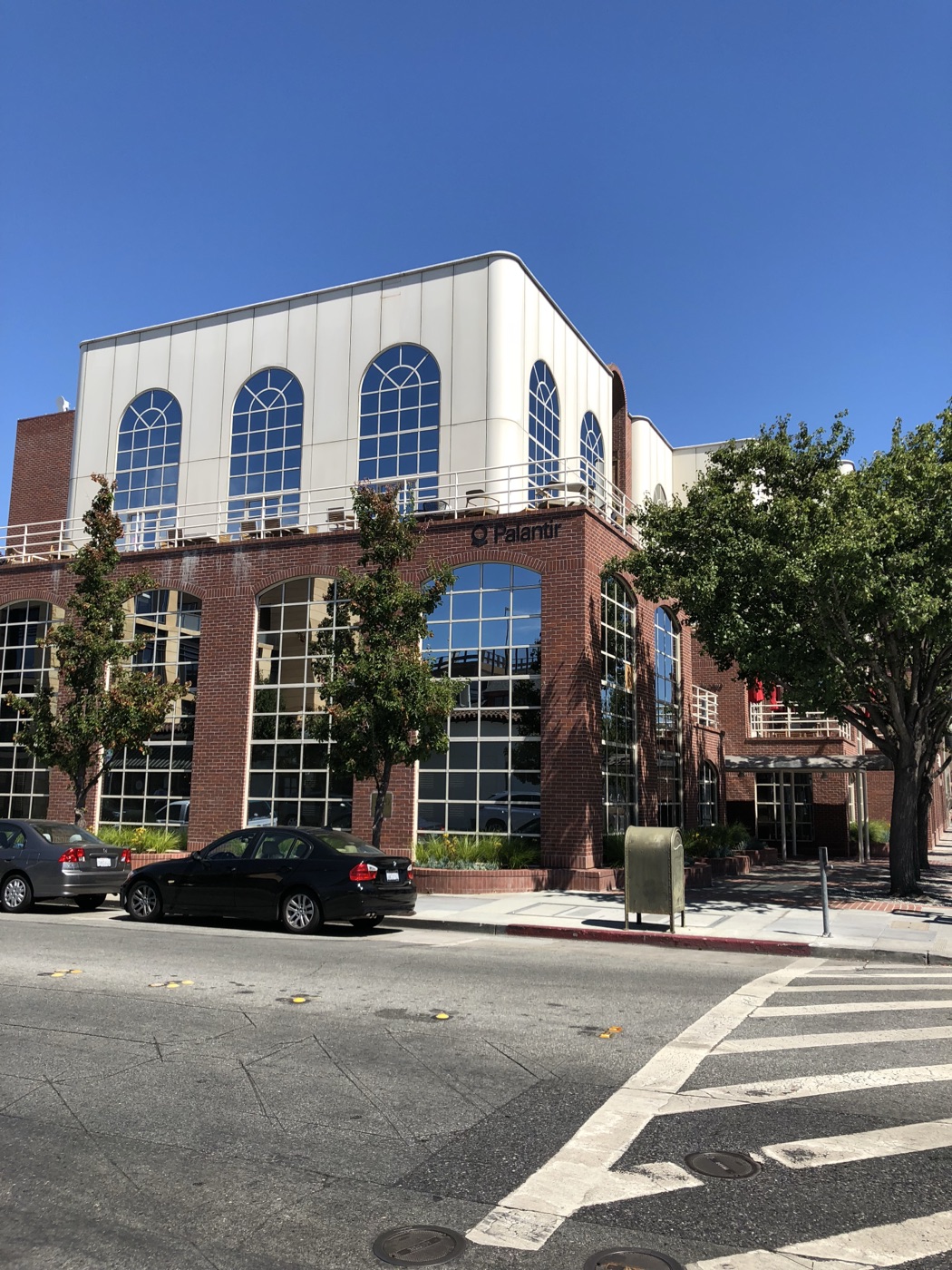
Image: Wikimedia Commons / CC BY-SA 4.0.
| KPI | Value | Notes |
|---|---|---|
| FY2025 Revenue | $4.48B · YoY +56% | FY2024: $2.87B · FY2023: $2.23B |
| FY2025 Net income | $1.63B · YoY +249% | FY2024: $467.9M · net margin 36.5% |
| Adjusted operating income | $2.25B · Adj Op Margin 50% | FY2024 only 39% · ex-SBC & payroll tax |
| Free cash flow | $2.10B · FCF Margin 47% | OCF $2.13B − Capex $34M |
| U.S. Commercial growth | +109% · FY25 $1.5B vs FY24 $702M | AIP-driven · Q3 alone +121% |
| Remaining Deal Value (RDV) | $11.2B · Commercial $6.8B · Govt $4.4B | Includes optional periods · not RPO |
| Rule of 40 | 106 · +56% growth + 50% adj margin | Rare combination of high-growth + high-margin |
| Cash + marketable securities | $7.18B · zero interest-bearing debt | Cash $1.42B + securities $5.75B |
2025 was the year Palantir completed its commercial-narrative pivot: the U.S. Commercial segment rose from $457M in FY23 to $702M in FY24 to $1.5B in FY25 (3.3× over two years, 81% CAGR), surpassing the largest historical government-account size for the first time. At the same time GAAP net income crossed $1B and adjusted operating margin hit 50%, forming a “high growth + high margin” double-high combination — and explaining the valuation premium the market is willing to pay.
— Compiled from 10-K / 10-Q disclosures, not independently re-audited.
§02 · Business — government × commercial, US × international
Revenue · 4-way split
U.S. Commercial has jumped to the second-largest segment ($1,500M, 33.5%); U.S. Government still leads ($1,820M, 40.7%) but is being squeezed in relative weight by U.S. Commercial. International Commercial $573M, International Government $582M — international is “balanced but slow.” Across the four quadrants, U.S. Commercial is the only +100%+ segment.
U.S. Commercial · growth curve
Quarterly U.S. Commercial YoY: Q2 +92.5% → Q3 +121% → Q4 implied +149%. After AIP, the “TTT bootcamp” model (Try → Trial → Transform) compresses sales cycles to weeks; management did not disclose a 2025 customer count, but ARR per customer and RDV density both lifted.
Revenue by geography
U.S. share rose from 66% in FY24 to 74% ($3,320M); U.K. $427M (10%), Rest of World $728M (16%). The larger North America weight is not international shrinking but U.S. commercial/government simultaneously accelerating.
Adj operating margin & Rule of 40
Adjusted operating margin: 28% in FY23 → 39% in FY24 → 50% in FY25; Rule of 40 jumped from 54 to 106, a 2-3 standard-deviation outlier among SaaS / data-analytics peers.
Quarterly revenue & YoY growth
§03 · P&L — operating leverage fully engaged
Income statement (quarterly + FY)
SEC disclosure basis · USD thousands.
| Item | Q2 25 | Q3 25 | Q4 25* | FY 25 | FY 24 |
|---|---|---|---|---|---|
| Revenue | 1,003,697 | 1,181,092 | 1,406,802 | 4,475,446 | 2,865,507 |
| › Government | 515,000 | 604,040 | 781,162 | 2,402,287 | 1,569,605 |
| › Commercial | 488,697 | 577,052 | 625,640 | 2,073,159 | 1,295,902 |
| Cost of revenue | 192,934 | 207,307 | 208,032 | 789,177 | 565,990 |
| Sales & marketing | 243,788 | 274,636 | 302,126 | 1,056,859 | 887,755 |
| R&D | 135,043 | 144,191 | 143,554 | 557,677 | 507,878 |
| G&A | 162,615 | 161,702 | 177,442 | 657,718 | 593,481 |
| Operating income | 269,317 | 393,256 | 575,394 | 1,414,015 | 310,403 |
| Net income | 328,572 | 476,748 | 611,607 | 1,634,644 | 467,918 |
| Diluted EPS | 0.13 | 0.18 | 0.22* | 0.63 | 0.19 |
| Adj operating income | — | — | — | 2,254,100 | 1,128,062 |
| Adj operating margin | — | — | — | 50% | 39% |
* Q4 2025 is derived from FY2025 minus 9M 2025 (Q3 10-Q) and is not separately disclosed. Q4 government/commercial and S&M/R&D/G&A are estimated by quarterly allocation.
Margin progression
FY2025 GAAP operating margin 31.6%, up 21 percentage points from FY24’s 10.8%. Gross margin moved from 80% to 82%; ex-SBC, Adj Op Margin reached 50%, crossing the Adj-50 threshold for the first time.
Contribution Margin · by segment
As-reported segment basis · ex-SBC · ex-unallocated R&D / G&A.
| Item | FY 2025 | FY 2024 | FY 2023 |
|---|---|---|---|
| Government segment revenue | 2,402,287 | 1,569,605 | 1,222,215 |
| › Government segment expense | (826,217) | (621,165) | (497,245) |
| › Government Contribution | 1,576,070 (66%) | 948,440 (60%) | 724,970 (59%) |
| Commercial segment revenue | 2,073,159 | 1,295,902 | 1,002,797 |
| › Commercial segment expense | (706,532) | (524,394) | (482,212) |
| › Commercial Contribution | 1,366,627 (66%) | 771,508 (60%) | 520,585 (52%) |
| Total Contribution | 2,942,697 (66%) | 1,719,948 (60%) | 1,245,555 (56%) |
Both segments’ contribution margins are now 66%; Commercial moved from 52% → 66% in two years, showing the high-value, scale-driven dynamic of AIP-driven commercial customers: Palantir hardly needs to expand its sales team to win new customers — the root reason Rule of 40 reached 106.
§04 · Balance — fortress balance sheet
Balance sheet · two-period comparison
12/31 2025 vs 12/31 2024 · USD thousands.
| Item | Dec 31, 2025 | Dec 31, 2024 |
|---|---|---|
| Cash & equivalents | 1,423,796 | 2,098,524 |
| Marketable securities | 5,753,247 | 3,131,463 |
| Accounts receivable | 1,042,065 | 575,048 |
| Total current assets | 8,358,174 | 5,934,289 |
| Property & equipment (net) | 51,960 | 39,638 |
| Right-of-use assets | 200,105 | 200,740 |
| Total assets | 8,900,392 | 6,340,884 |
| Accounts payable | 8,064 | 103 |
| Deferred revenue | 408,963 | 259,624 |
| Customer deposits | 357,066 | 265,252 |
| Current liabilities | 1,175,581 | 996,018 |
| Total liabilities | 1,412,381 | 1,246,477 |
| Stockholders’ equity | 7,387,268 | 5,003,275 |
| Non-controlling interest | 100,743 | 91,132 |
| Total equity | 7,488,011 | 5,094,407 |
Cash + marketable securities · trend
Liquid assets grew from $5.23B at end-FY24 to $7.18B (+37%); zero interest-bearing debt, zero goodwill on the balance sheet (no large M&A ever). FY25 free cash flow plus SBC adds back, so net cash continues to accumulate.
Three-class structure · A / B / F
Class A (1×) / Class B (10×) / Class F (variable → 49.999%).
| Class | Shares | Voting share |
|---|---|---|
| Class F (variable voting) | 1.005M | 49.999% |
| Class B (10 votes/share) | 99.2M | 29% |
| Class A (1 vote/share) | 2,291M | 21% |
Class F = founder-only super-vote: per the charter, as long as the founders’ (Karp / Cohen / Thiel) combined Class A + Class B + Class F holdings do not exceed 49.999999% of the vote, Class F is automatically granted “enough votes” to lock at 49.999%; even if their economic stake is diluted toward 0%, they retain near-half voting power — a rare “anti-dilution voting anchor” mechanism.
Assets vs liabilities · structure
§05 · Cash Flow — cash-generating engine
OCF / FCF / SBC comparison
Cash flow takeaways
- OCF nearly doubles. FY2025 operating cash flow $2.13B, +85% YoY; FCF $2.10B (capex only $33.9M), FCF margin 46.9%.
- Capex extremely low. FY2025 capex $33.9M, 0.8% of revenue — typical “asset-light · cloud-native” structure; also reflects that Palantir does not run its own data centers (uses AWS / Azure / GovCloud).
- SBC ratio falling. FY25 SBC $684M vs FY24 $692M — flat in absolute terms but the ratio dropped from 24% of revenue (FY24) to 15.3%, normalizing toward mature SaaS levels.
- Investing activities consumed $2.78B. Mainly used to buy marketable securities (purchases $7.7B, redemptions $5.03B); financing net outflow $26.9M, no buybacks, no dividends; period-end cash $1.42B (down $0.68B vs FY24 due to longer-duration security allocation).
§06 · Leadership — who’s running this
Named Executive Officers
The following are the named executives identified from the FY2025 10-K (filed 2026-02-17) signature pages and compensation tables. Palantir’s core C-suite has barely changed since its 2020 direct listing; the founder trio Karp / Cohen / Thiel locks 49.999% voting power via Class F — a rare case of full-stack founder control.
| Role | Name | Notes |
|---|---|---|
| CEO · Co-founder | Alexander C. Karp | Chief Executive Officer & Director · Co-founder. Co-founded Palantir in 2003 with Peter Thiel, Stephen Cohen, and Joe Lonsdale; public persona of “philosophy PhD + contrarian investor”; serves as the company’s spokesperson on its ideology and Western-values commercialization narrative. Locks in voting power via the Founder Voting Agreement + Class F. |
| President · Co-founder | Stephen Cohen | President & Director · Co-founder. One of Palantir’s co-founders, long-time leader on product and engineering; forms the CEO-President dual-signing structure with Karp. Signs the 10-K as President, holds substantial Class B shares. |
| CTO | Shyam Sankar | Chief Technology Officer · EVP. Joined as employee #13 in 2006; prior FDSE / COO / Global Business Lead; CTO since 2022. Drives the AIP roadmap and has direct influence over government customer relationships and the Commercial TIP model. |
| CFO | David Glazer | Chief Financial Officer · Treasurer. CFO since before the direct listing; responsible for capital-markets communication and the non-GAAP disclosure regime (Adj Op Margin, Rule of 40, etc.). Signs the 10-K as Principal Financial Officer. |
Executive change log
Q2 2025 – FY2025 · 10-Q / 10-K / 8-K disclosures.
- 2025-Q2. No executive departures or new appointments; Palantir admitted to the S&P 500 in April.
- 2025-Q3. No executive changes; RDV crossed $10B and was disclosed for the first time.
- 2025-Q4. No executive changes; no Item 5.02 events on the 10-K.
- Stability. Core C-suite has been unchanged since the 2020 direct listing; the founder team remains intact.
Board of Directors
8 signing directors · 2026-02 10-K signature page.
| Director | Role |
|---|---|
| Alexander C. Karp | CEO · Founder |
| Stephen Cohen | President · Founder |
| Peter Thiel | Chairman · Founder |
| Lauren Friedman Stat | Independent |
| Alexander Moore | Director |
| Alexandra Schiff | Director |
| Eric Woersching | Independent |
| Jeffrey Buckley | CAO (Principal Accounting) |
Three founders (Karp / Cohen / Thiel) all serve as directors; via the Founder Voting Agreement + Class F mechanism, their combined voting power is locked at 49.999% — even if their economic stake is diluted toward zero by equity comp, they can still block most shareholder proposals, similar in spirit to NYSE “controlled company” exemptions.
§07 · Risk — what could derail this
- Government customer concentration. FY2025 government revenue $2.40B was 53.7% of total, of which U.S. government was ~$1.9B; the FY23 10-K once disclosed “top 20 customers = 50%+ of revenue.” Federal continuing-resolution standoffs, shutdowns, or administration changes that pause procurement directly affect quarter-on-quarter revenue recognition; the 10-K lists this as a top risk.
- Contract cyclicality & termination clauses. RDV’s $11.2B nominal value is large, but much of it carries termination-for-convenience clauses; U.S. federal contracts are also barred from prepaid options exceeding 1 year. The realized revenue from RDV is paced by federal budget cycles. RDV → revenue conversion is not 1:1.
- Controversial deployments & reputation risk. Palantir has long faced public controversy over deployments with ICE, IDF, the Israeli Defense Forces, and DoD programs; any leak, accident, or media flare-up at a key deployment could trigger employee attrition, university/corporate boycotts, or ESG fund reductions (the 10-K lists this as a standalone risk).
- China risk & geopolitics. The company explicitly does not sell to Chinese government / military customers, which is part of its product positioning; but (a) if U.S./EU regulations further restrict AI exports, Palantir’s international commercial contracts may also face limits; and (b) Western customers want to see a “tough-on-China” stance, requiring the company to maintain high political visibility, amplifying the fragility of a politicized narrative.
- Founder control · Class F structure. The three founders lock 49.999% voting power via Class F + the Founder Voting Agreement, so shareholders cannot vote to change the board or push major transactions. Minority governance rights are heavily diluted; potential downgrade in S&P 500 governance scores could affect index-fund weighting. The Class F mechanism is also “unprecedented in design” under the SEC framework — a future challenge could trigger disclosure risks.
Bottom line · Double-high structure achieved; the valuation anchor is U.S. Commercial.
Palantir completed its FY2025 narrative pivot from “government contractor” to “AI-era enterprise operating system.” The valuation anchor for the next 1-2 years lands on:
- Whether U.S. Commercial can hold 80-100%+ growth
- Direct AIP ARR disclosure (investors are calling for it)
- Whether Adj operating margin can hold above 50%
- Government contract cycle disruptions to quarterly cadence
- Whether Class F faces legal challenge
“Rule of 40 at 106 · net cash $7B · zero interest-bearing debt” — these three pillars support the current valuation premium.
§08 · Valuation — valuation in context
PLTR current valuation
Data as of 2026-04-20 · close.
| Metric | Value |
|---|---|
| Price | $146.39 |
| Market cap | $348.6B |
| P/E (TTM) | 231.3× |
| P/S (TTM) | 85.2× |
| EV/EBITDA | 238.3× |
| FCF Yield | 0.6% |
| 52W range | $89.31–$207.52 |
Peer benchmark
Enterprise Data & SaaS · TTM · latest.
| Ticker | Price | Mkt cap | P/E | P/S | EV/EBITDA | FCF Yield |
|---|---|---|---|---|---|---|
| PLTR | $146.39 | $348.6B | 231.3× | 85.2× | 238.3× | 0.6% |
| NOW | $97.10 | $101.1B | 57.9× | 7.2× | 33.8× | 3.4% |
| DDOG | $123.47 | $38.3B | 410.8× | 14.0× | N/M | 2.4% |
| SNOW | $144.00 | $49.8B | N/M | 20.7× | N/M | 2.2% |
PLTR’s valuation sits well above the rest of the data/SaaS cohort: P/S of 85× is 12× NOW’s (7×) and 4× SNOW’s (21×); P/E 231× is exceeded only by DDOG (small-base distortion), with NOW the only “normally priced” peer (P/E 58×, EV/EBITDA 34×). The premium is supported by three pillars: (1) Rule of 40 = 106 is roughly 2× NOW/DDOG (~50), none of the peers can replicate “56% growth + 50% adj margin”; (2) AIP as the GenAI-era “enterprise operating system” anchor — the market is pricing the next 5-year curve, not TTM; (3) institutionalized irreplaceability of government contracts (FedRAMP High, Impact Level 6, ICE/DoD ties). Downside risk: if U.S. Commercial growth steps down from +109% to +40-50%, Rule of 40 quickly retreats toward 80, and multiples compress 30-40% — even with healthy fundamentals.