Ad cash cow shoulders AI capex.
Meta FY2025 revenue was $200.97B (+22.2%); GAAP operating margin moved from 42.2% to 41.4% — but net income fell -3% YoY because of a $15.9B one-off income tax charge from the July OBBBA tax act. Reality Labs operating loss widened to $(19.2B) and capex doubled to $69.7B (AI infra). This research is built on the three primary SEC filings — FY2025 10-K + Q3 2025 10-Q + Q2 2025 10-Q. Figures in USD millions.
Quick numbers
| Item | Value |
|---|---|
| Ticker | NASDAQ : META |
| CIK | 0001326801 |
| FY25 Revenue | $200.97B (+22.2%) |
| Net income | $60.46B (-3.0%) |
| DAP · Dec | 3.58B (+7%) |
| Capex | $69.69B (+87%) |
§01 · Key Metrics — the year at a glance
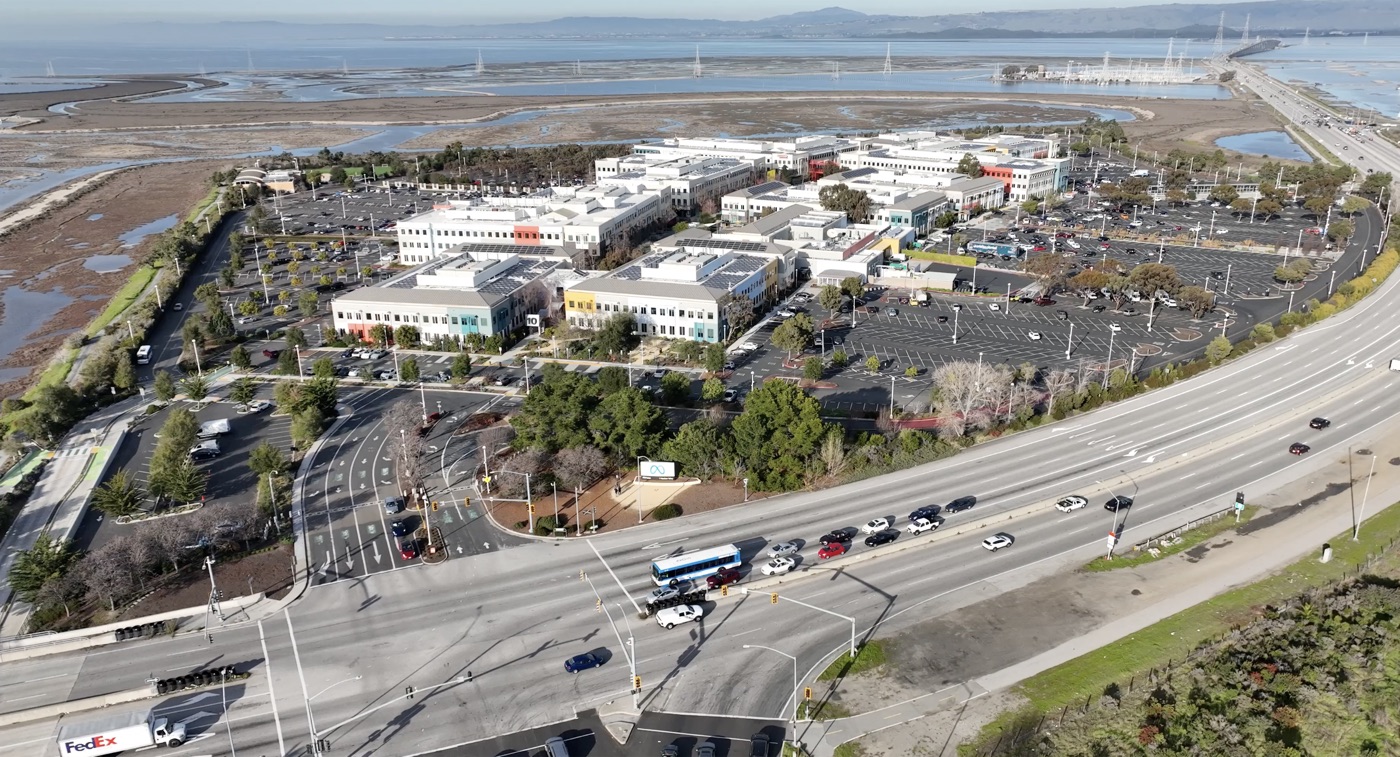
Image: Wikimedia Commons / CC BY-SA 4.0.
| KPI | Value | Notes |
|---|---|---|
| FY2025 Revenue | $200.97B · YoY +22.2% | FY2024 $164.50B · FY2023 $134.90B |
| FY2025 Net income | $60.46B · YoY -3.0% | Includes $15.9B one-off OBBBA charge · adj. NI ~$76B |
| Operating income | $83.28B · +20.0% | Operating margin 41.4% · roughly flat YoY |
| Free cash flow | $46.11B · -14.7% | OCF $115.8B – Capex $69.7B |
| Cash + marketable securities | $81.59B · +4.8% | Cash $35.87B · securities $45.72B |
| Daily Active People | 3.58B · +7% YoY | Dec 2025 average; prior year 3.35B |
| Capex | $69.69B · +87% | AI infra / data centers; FY24 $37.26B |
| Reality Labs loss | $(19.19)B · loss widened +8% | RL revenue $2.21B · loss/revenue >8× |
2025 is Meta’s “year one of AI capitalization”: capex jumped from $37B to $70B, long-term debt doubled from $28.8B to $58.7B, and PP&E rose from $121B to $176B. Family of Apps (FoA) operating income of $102.5B carried Reality Labs’s $19.2B loss and provided the rare cash-generating capacity to fund the AI infrastructure expansion. The market’s core debate: is this round of capex 15-year amortizable infrastructure, or a trap that gets quickly impaired by the next generation of AI hardware?
— Synthesis of 10-K / 10-Q disclosures; data not independently audited
§02 · Business — segments, geography, users
Revenue mix · Family of Apps vs Reality Labs
FoA ads $196.2B + other $2.6B = $198.8B (98.9%); Reality Labs only $2.2B (1.1%). But on operating income the two offset dramatically: FoA earned $102.5B, RL lost $(19.2B), with the $83.3B difference equal to consolidated operating income.
Geographic mix · four regions
US & Canada $78.9B (39.2%) · Europe $46.6B (23.2%) · Asia-Pacific $53.8B (26.8%) · Rest of World $21.7B (10.8%). APAC grew +19.6% YoY — the fastest-growing region — as ad demand from cross-border merchants like Shein and Temu kept spilling over.
Family of Apps vs Reality Labs · 3-year operating income
FoA operating income trajectory: $62.9B → $87.1B → $102.5B (CAGR 27.6%); RL loss simultaneously widening: $(16.1B) → $(17.7B) → $(19.2B). RL has burned a cumulative $53B over three years, and FY2025 RL revenue grew just +2.8% — monetization is far from realized.
Daily Active People (DAP) · annual
DAP December average rose from 3.35B (2024) to 3.58B (2025), +7% YoY. Against a global adult internet population of ~5B, Family reach is approaching 72%, near TAM saturation — growth is increasingly dependent on ARPP rather than user expansion.
Ad engine · volume + price both up
Ad impressions FY2025 +12% YoY (vs FY24 +11%), average price per ad +9% YoY (vs FY24 +10%). Volume + price both contributed, explaining the acceleration in ad revenue $131.9B → $160.6B → $196.2B, while DAP grew only 7% — price-driven growth meaningfully outpaced volume for the first time.
Quarterly revenue & YoY
§03 · P&L — where the AI money goes
Income statement (annual + quarterly)
USD millions · disclosed basis.
| Item | Q2 25 | Q3 25 | Q4 25* | FY25 | FY24 |
|---|---|---|---|---|---|
| Revenue | 47,516 | 51,242 | 59,893 | 200,966 | 164,501 |
| › Advertising | — | — | — | 196,175 | 160,633 |
| › Other (FoA) | — | — | — | 2,584 | 1,722 |
| › Reality Labs | — | — | — | 2,207 | 2,146 |
| Cost of revenue | — | — | — | 36,175 | 30,161 |
| R&D | 12,942 | 15,144 | 17,135 | 57,372 | 43,873 |
| Sales & marketing | 2,979 | 2,845 | 3,410 | 11,991 | 11,347 |
| G&A | 2,663 | 3,512 | 3,697 | 12,152 | 9,740 |
| Total costs | 27,075 | 30,707 | 35,161 | 117,690 | 95,121 |
| Operating income | 20,441 | 20,535 | 24,745 | 83,276 | 69,380 |
| Interest & other, net | — | — | — | 2,656 | 1,283 |
| Income tax | — | — | — | 25,474 | 8,303 |
| Net income | 18,337 | 2,709 | 22,768 | 60,458 | 62,360 |
| Diluted EPS (USD) | 7.14 | 1.05 | 8.82 | 23.49 | 23.86 |
* Q4 2025 derived as FY2025 minus 9M 2025. Q3 2025 net income was dragged by a $15.9B one-off OBBBA tax charge.
Margin trajectory
Operating margin FY23 34.7% → FY24 42.2% → FY25 41.4%, holding above 40%; but R&D as a share of revenue was flat at 28.5% (incl. Reality Labs $10.8B + AI R&D) — the ad engine’s margin is being diluted by ongoing AI and VR investment.
R&D decomposition · accelerating
R&D rose from FY23’s $38.5B to FY25’s $57.4B (+49% over two years). Combined with $10.8B of Reality Labs employee comp and physical product cost, RL + AI R&D is estimated at 45-50% of total R&D.
§04 · Balance — balance sheet in AI mode
Balance sheet · FY2024 vs FY2025 end
USD millions · Dec 31.
| Item | 2024-12-31 | 2025-12-31 |
|---|---|---|
| Cash & equivalents | 43,889 | 35,873 |
| Marketable securities | 33,926 | 45,719 |
| Accounts receivable, net | 16,994 | 19,769 |
| Total current assets | 100,045 | 108,722 |
| Non-marketable equity investments | 6,070 | 27,524 |
| › incl. strategic stakes (e.g., Scale AI) | — | — |
| PP&E, net | 121,346 | 176,400 |
| Operating lease right-of-use assets | 14,922 | 20,404 |
| Goodwill | 20,654 | 24,534 |
| Total assets | 276,054 | 366,021 |
| Accounts payable | 7,687 | 8,894 |
| Operating lease liabilities (total) | 20,234 | 25,153 |
| Long-term debt | 28,826 | 58,744 |
| Long-term income taxes payable | 9,987 | 21,005 |
| Total liabilities | 93,417 | 148,778 |
| Additional paid-in capital | 83,228 | 95,793 |
| Retained earnings | 102,506 | 121,179 |
| Stockholders’ equity | 182,637 | 217,243 |
Asset structure · turning hard-asset
PP&E, net rose from $97B (FY23) to $121B (FY24) to $176B (FY25) — +82% in two years. The 15-year disclosed depreciation schedule on AI data centers will weigh on operating margins for years — the biggest bear case on Meta in the market today.
Capital structure · dual-class
Class A (1 vote · 2,187M shares) vs Class B (10 votes · 343M shares). By share count, Class A is 86.4%, but Class B (held primarily by Zuckerberg and related entities) has 10 votes per share, giving it ~61.1% of the vote; Zuckerberg’s economic interest is ~13%, his vote ~60% — absolute control. The dual-class structure has not changed since the 2012 IPO.
| Class | Shares | Voting share |
|---|---|---|
| Class B (10× voting) | 343M | 61.1% |
| Class A (1 vote) | 2,187M | 38.9% |
Liabilities and debt · from “net cash” to “net borrower”
2024 end: cash + securities $77.8B, long-term debt $28.8B — net cash $49B. 2025 end: cash + securities $81.6B, long-term debt $58.7B (two ~$30B IG tranches issued during the year) — net cash narrowed to $22.8B. Meta is accelerating debt issuance to lock in low rates and smooth capex.
§05 · Cash Flow — cash in, capex out
OCF / FCF / Capex / SBC / Buybacks / Dividends
Cash flow takeaways
- OCF jumps to $115.8B. +26.8% YoY (FY24 $91.3B); the ad engine is still one of the largest non-financial OCF generators in the world.
- Capex doubled to $69.7B. Almost entirely AI GPU server clusters and supporting data centers; FY2026 management guidance is $100–115B (H100/H200/MI300 + in-house MTIA).
- FCF declines for the first time. FCF fell from $54.1B in FY24 to $46.1B — the first time capex has outgrown OCF on an incremental basis.
- Buybacks + dividends = $31.6B. Buybacks $26.2B · dividends $5.3B ($2.10/share) · SBC $20.4B — combined shareholder return was ~45% of OCF.
Capex · three-year leap
Capex cadence: $27.0B → $37.3B → $69.7B. Per latest management guidance (1/29/2026 earnings call), FY2026 capex extends to $100–115B. If OCF holds 25% growth, FCF could fall to $30–40B or lower in FY2026.
§06 · Leadership — who’s running this
Named Executive Officers
The following are the named executives identified in the FY2025 10-K filed 2026-01-29 and related proxy statements. No C-suite departures or appointments during the period (no Item 5.02 disclosures in 10-K / Q2 / Q3).
| Role | Name | Notes |
|---|---|---|
| CEO · Co-Founder | Mark Zuckerberg | Chairman & Chief Executive Officer · Co-Founder. Founded Facebook in 2004; together with Class B shares and voting agreements, controls about 60% of the vote. From 2024 has driven AI hyperscale investment, and personally led the 2025 reorganization of Superintelligence Labs. |
| CFO | Susan Li | Chief Financial Officer. Took over as CFO in 2023-11 from David Wehner; previously served as VP Finance for over a decade. Leads capital structure and the AI capex narrative; initiated a new 10b5-1 sale plan (up to 112,273 shares) in January 2026. |
| COO | Javier Olivan | Chief Operating Officer. Took over the COO role from Sheryl Sandberg in 2022-08; focuses on global operations, infrastructure, and efficiency, with a core voice in data-center build-out and capex decisions. |
| CPO | Chris Cox | Chief Product Officer. An early Facebook product leader; briefly left in 2019, returned in 2020. Coordinates the Family of Apps product roadmap and the Reality Labs AI Glasses interfaces. |
Executive change log
Q2 2025 – FY2025 · 10-Q / 10-K / 8-K disclosures.
- 2025-Q2. No executive departures or new hires; multiple long-term debt issuances ($10.5B).
- 2025-Q3. OBBBA enacted, generating a $15.9B one-off income tax charge; Reality Labs internal reorg, with original head Andrew Bosworth retained.
- 2025-Q4. Formed Meta Superintelligence Labs; Alexandr Wang (former Scale AI CEO) appointed Chief AI Officer, reporting in parallel with Yann LeCun.
- Stability. Core C-suite stable since the 2023 CFO handoff; Zuck control and strategic direction are aligned.
Board of Directors (selected)
10 directors · 2026-01 10-K signature page.
| Director | Role |
|---|---|
| Mark Zuckerberg | Chair · CEO |
| Peggy Alford | Independent |
| Marc Andreessen | Venture · Lead |
| Drew Houston | Independent |
| Nancy Killefer | Independent |
| Robert Kimmitt | Independent |
| Hock Tan | Independent |
| Tracey Travis | Independent |
| Tony Xu | Independent |
| John Arnold | Independent |
Meta is a dual-class controlled company under Nasdaq rules; independents are the majority but Zuckerberg holds effective veto over major actions. Jennifer Newstead serves as Chief Legal Officer (non-board), navigating the complex framework of DMA / DSA / US FTC/DOJ and AI regulations.
§07 · Risk — what could derail this
- AI capex investment payback cycle. FY2025 capex of $69.7B and FY2026 guidance of $100–115B implies cumulative AI hardware spend exceeding $200B in two years. Depreciation will drag future margins by $25-40B annually. If gen-AI inference prices keep falling (GPU oversupply), asset-impairment risk is non-trivial — currently the most concentrated bear case.
- Reality Labs losses widening. RL has lost $53B over three years against just $6.2B in revenue — losses/revenue >8×; the new Meta Glasses launched in 2025 still carry high cost. Quest headset sales remain weak, and AR-glasses commercialization timelines are still vague. The market values RL at roughly zero or slightly negative.
- Ad cyclicality + SMB concentration. Ads are 97.6% of revenue; SMB advertisers (>50% of Meta’s ad revenue) cut budgets sharply in macro downturns. Cross-border China e-commerce ads (Temu/Shein) contributed a meaningful share of 2024-25 incremental — once tariffs or compliance tighten, APAC growth would be directly hit.
- Regulatory · DMA / DSA / antitrust. EU DMA requirements on personalized ads, US FTC antitrust suit (seeking divestiture of Instagram/WhatsApp), DOJ digital-ads investigation, plus state-level child-safety bills — all carry material fine and business-restructuring exposure. Multiple multi-hundred-million euro DMA/GDPR fines have already landed in 2024-25.
- Content moderation and AI trust. Generative AI–driven misinformation, deepfakes, and brand-safety issues have prompted some major advertisers to demand isolation from AI-generated content. Meta’s 2025 shift toward “Community Notes”–style moderation may also affect public trust and regulator relationships.
Bottom line · Ad cash cow + AI infrastructure mega-bet.
Meta in 2025 completed the narrative pivot from “pure ad company” to “AI hyperscaler.” Pricing-key questions for the next year:
- Whether $100B+ FY2026 capex accelerates AI-recommendation / Meta AI revenue
- Whether Reality Labs losses peak in 2026
- The cadence of long-term debt issuance and credit-spread moves
- The trajectory of the FTC antitrust suit (Instagram/WhatsApp divestiture)
“Zuck control absolute · FoA operating income above $100B · but asset quality is being reshaped by AI capex”
§08 · Valuation — valuation in context
META current valuation
Data as of 2026-04-18 · close.
| Metric | Value |
|---|---|
| Price | $662.49 |
| Market cap | $1.70T |
| P/E (TTM) | 28.8× |
| P/S (TTM) | 8.5× |
| EV/EBITDA | 15.6× |
| FCF Yield | 2.7% |
| 52W range | $479.80–$796.25 |
Peer benchmark
TTM multiples · latest.
| Ticker | Price | Mkt cap | P/E | P/S | EV/EBITDA | FCF Yield |
|---|---|---|---|---|---|---|
| META | $662.49 | $1.70T | 28.8× | 8.5× | 15.6× | 2.7% |
| GOOGL | $341.68 | $4.13T | 31.3× | 8.7× | 27.1× | 1.7% |
| SNAP | $6.13 | $10.2B | N/M | 2.3× | N/M | 3.2% |
| PINS | $20.29 | $13.4B | 30.2× | 3.0× | 27.2× | 8.5% |
META at 28.8× P/E and 15.6× EV/EBITDA — relative to SNAP (not yet stably profitable, EBITDA negative) and PINS (P/E 30.2× but only $13B in size) — has a premium underpinned by the $102.5B FoA operating income and the world’s largest non-search ad engine. This isn’t a simple multiple gap, but a moat gap. Versus GOOGL at P/E 31.3× / EV/EBITDA 27.1×, META is actually nearly 11 turns cheaper on EV/EBITDA: search-ad gross margin is structurally above feed-ad gross margin, and the market has awarded GOOGL a premium for AI (Gemini + Cloud), but META still leads on ad ROAS. The most material AI-capex impact is on FCF Yield — META’s 2.7% may compress further to 1.5–2% under FY2026 capex guidance of $100–115B, below the 10Y Treasury, the core bear leg in the current valuation. In addition, Reality Labs’s $(19.2B) annual loss implicitly weighs on the P/E denominator by ~4-5 points — measured on an FoA-only basis, META’s “true P/E” is around 23×, which explains why most institutions value RL at zero or even negatively.