When oil cannot hold, gold runs ahead.
Over the past twelve months commodities split in a way that does not show up often: oil prices were yanked back and forth between OPEC+ “supply management” and weak Chinese demand, with WTI briefly slipping below $58 toward the bottom of the Goldilocks band; gold, meanwhile, was driven by central-bank “de-dollarisation” buying + a geopolitical premium + falling real rates in three-factor resonance, refreshing prints from $3,200 all the way up to $4,800+, with annual gains close to 50%. This page lays out both curves, plus the four macro tethers connecting them — DXY, the 10-year Treasury, OPEC+ decisions, and the Fed path — on a single canvas.
§01 · Overview — a big-picture recap
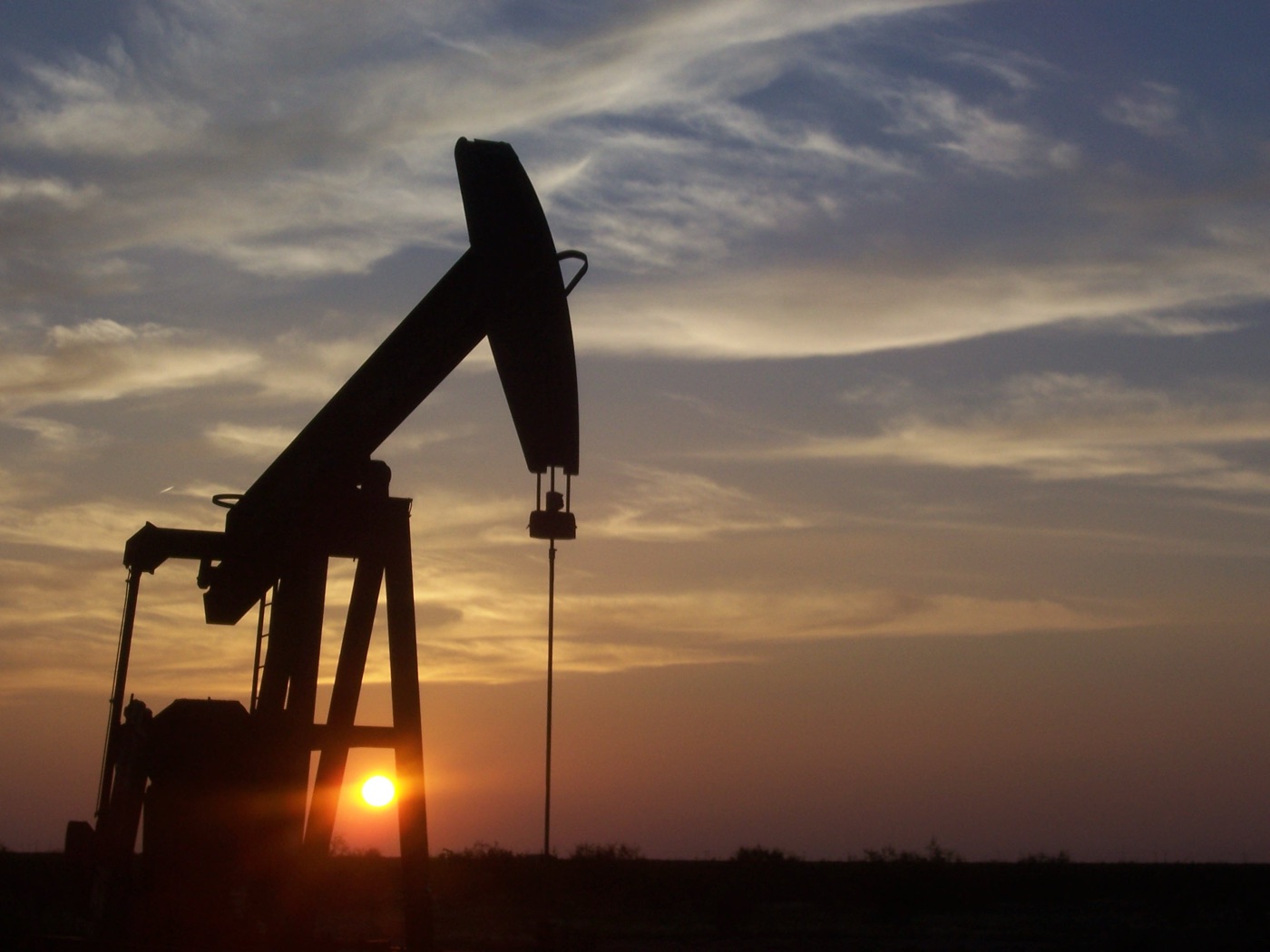
Image: Wikimedia Commons / Public Domain.
Compress the window from April 2025 to April 2026 into one line: energy traded the “oversupply narrative” while precious metals traded the “credit narrative”. Oil began at the $80 handle in late spring 2025, and was pushed down to the $55–60 lows of September–October 2025 by OPEC+‘s early-April production-add plan and a string of soft China PMIs. Three Fed cuts (Sep / Oct / Dec), OPEC+‘s November pivot to “pause the add”, and a US–Iran crisis with Hormuz-blockade threats in March–April 2026 then bumped it back up to $90+.
Gold travelled a different path — not a V but a near-uninterrupted staircase. Central-bank gold buying topped 1,000 tonnes for a third straight year. Combined with a structurally weaker dollar (DXY from $105 down to $98) and falling real Treasury yields, gold first broke $4,000 in October 2025 and printed an all-time high of $4,878 in April 2026. The main buyers remained the central banks of China, India, Poland, and Türkiye, which together accounted for roughly 42% of central-bank purchases.
| Metric | Value | Delta | Notes |
|---|---|---|---|
| WTI crude | $88.8 /bbl | +14% 12M | Range $55–$94 |
| Brent crude | $95.4 /bbl | +44% YoY | Range $58–$96 |
| Gold spot | $4,868 /oz | +50% YoY | All-time high $4,878 |
| DXY / 10Y | 98.3 / 4.26% | −7% / −0.15bp | Weaker dollar + lower rates |
Bottom Line · The single most important macro shift this year: “real rates × geopolitical premium” became the pricing core.
Oil reacts to physical supply and demand — it swings, but it mean-reverts. Gold reacts to distrust in the credit and monetary system — once it starts moving, it does not turn easily. Standing between the two curves are three variables: the dollar index, the 10-year real rate, and OPEC+‘s pricing power. Get those three straight, and the rest of this page is footnotes.
§02 · Oil — the oil roundtrip
If you look only at the start and end points of oil’s V, it does not look like much — but the story in the middle reflects three regime changes in 2025–2026 global oil pricing: oversupply narrative → supply reset → geopolitical premium.
Sources: EIA / Trading Economics / Macrotrends. Approximate monthly closes. 2026-04 reflects the latest intra-month print (Apr 20).
Three acts
(1) 2025 Q2–Q3 · oversupply narrative. In April 2025 OPEC+ announced an accelerated production restoration; combined with sub-49 China manufacturing PMI prints, WTI slid from $80 to $55–60 by September, with the year’s low around 2025-09. EIA cut its 2025 average forecast to ~$72/bbl during the period.
(2) 2025 Q4 · supply reset. On Nov 2 OPEC+ paused the planned 2026 Q1 production restoration and kept the 3.2 mb/d voluntary cut intact; the Fed cut 75bp in total over Sep / Oct / Dec, weakening the dollar. Oil rebounded to $65–75.
(3) 2026 Q1–Q2 · geopolitical premium. US–Iran tensions escalated from March; the US-Navy interception of Iranian vessels in the Gulf of Oman on April 17–20 pushed Brent above $95. The market re-priced the probability of a Hormuz blockade — actual disruption risk is low, but a premium is a premium.
Monthly closes · 12 months
| Month | WTI $/bbl | Brent $/bbl | Spread | Key event |
|---|---|---|---|---|
| 2025-04 | 62.8 | 66.5 | +3.7 | OPEC+ accelerates May production add; gold prints $3,500 ATH same month |
| 2025-05 | 60.1 | 63.9 | +3.8 | China PMI 49.0; Brent breaks below $65 |
| 2025-06 | 65.8 | 69.2 | +3.4 | Brief rebound on tighter inventory data |
| 2025-07 | 67.5 | 71.0 | +3.5 | Summer demand support, but the forward curve stays in contango |
| 2025-08 | 64.9 | 68.1 | +3.2 | Statista: WTI monthly avg. $64.86 |
| 2025-09 | 58.2 | 61.5 | +3.3 | Year low. Fed cuts 25bp for the first time |
| 2025-10 | 61.0 | 64.3 | +3.3 | Gold breaks $4,000; no oil geopolitical premium yet |
| 2025-11 | 66.4 | 69.8 | +3.4 | OPEC+ pauses production add; Fed cuts a second time |
| 2025-12 | 69.7 | 73.0 | +3.3 | Fed cuts a third time; year-end close ~$70 |
| 2026-01 | 72.3 | 75.4 | +3.1 | OPEC+ Jan-4 meeting maintains the pause |
| 2026-02 | 70.9 | 74.1 | +3.2 | Volatility narrows |
| 2026-03 | 82.5 | 86.8 | +4.3 | US–Iran escalation; EIA lifts 2026 Brent average to $96 |
| 2026-04* | 88.8 | 95.4 | +6.6 | Hormuz tanker incident; intraday +5% |
* 2026-04 reflects the Apr 20 latest print; historical monthly figures are approximate month-end closes. Definitions: WTI = NYMEX CL1 prompt; Brent = ICE BR prompt.
Drivers
- OPEC+ pricing power returns. By mid-2025 the eight-nation coalition (Saudi, Russia, Iraq, UAE, Kuwait, Kazakhstan, Algeria, Oman) still kept about 3.2 mb/d (~3% of global demand) in voluntary cuts. The November decision to pause the 2026 Q1 restoration directly reset market expectations. JPM warning: without further cuts, 2026 oil could test $40.
- Structural softness in Chinese demand. China’s manufacturing PMI sat below 50 multiple times across 2025, while EV penetration accelerated and pressed gasoline demand. The IEA expects 2026 Q1 to be one of the largest inventory-build quarters in recent years, with daily builds reaching 5 mb/d. IEA: “One of the largest oversupplies in recent years”.
- US shale capital discipline. US shale production growth slowed visibly in the $60–65 band — bankruptcy memories plus shareholder dividend mandates have made Permian capex materially more restrained than the 2022–23 cycle. That lifts the floor. WTI < $60 sustained for two quarters triggers shale cuts.
- Three pulses of geopolitical premium. The Russia–Ukraine conflict continues but is fully priced. Real oil pulses came from the Middle East — June 2025 Red Sea tanker attacks, March 2026 US–Iran diplomatic breakdown, April 2026 Hormuz tanker interception, each adding $5–10 of risk premium. Hormuz carries ~20% of global seaborne crude.
- The Fed path and the dollar. The Fed cut three times in Sep / Oct / Dec 2025, bringing the fed-funds target to 3.50–3.75%. DXY slipped from $105 to $98, providing structural support for dollar-priced commodities. 2026 dot plot: one more cut to ~3.4% expected.
- EIA vs IEA: divergent expectations. In April the EIA raised its 2026 Brent forecast from ~$70 to $96, mainly reflecting persistent geopolitical premium; the IEA is still calling for “structural oversupply”. The gap between the two is the largest source of current market uncertainty. IEA: supply-loose | EIA: demand-tight.
“Oil in 2026 may end up as a $65–$95 rectangle, not a trend — because OPEC+ will cut whenever price gets too low and US shale will accelerate whenever price gets too high.”
— Internal note, energy desk at a major hedge fund, 2026 Q1
§03 · Gold — the gold straight line
Gold’s twelve months read like a textbook macro trade — falling real rates + a weakening dollar + central-bank buying + geopolitical hedging all firing in resonance. The wrinkle is that central-bank buying is not a short-term sentiment trade; it is the continuation of the structural migration that began in 2022 when Russia’s reserves were frozen. So it provides both a price floor and a re-rating of the entire gold curve.
Sources: Kitco / Trading Economics / World Gold Council. 2026-04 reflects the Apr 20 spot.
Four milestones
$3,500 · 2025-04 First break of the prior all-time high. Drivers: expanded US reciprocal tariffs + Russia–Ukraine talks stalled.
$4,000 · 2025-10 First four-digit handle. Drivers: Fed cutting cycle begins + PBoC adds gold for a tenth straight month.
$4,534 · 2025-12-26 Full-year 2025 high (USAGOLD basis).
$4,878 · 2026-04 New ATH. Drivers: US–Iran crisis + Fed-cut expectations intact + JPM / GS lift targets to $5,000–6,000.
Record High Callout · +50% in twelve months without a “systemic crash” backdrop is very unusual.
Across the past 50 years, gold has rallied more than 50% in twelve months only a handful of times: the 1979–80 oil shock, the 2008 GFC, and the 2020 COVID episode. What is different this time is that US equities are also at all-time highs and credit spreads are tight. The traditional “gold vs. risk asset” inverse-correlation narrative has been rewritten by the debasement trade.
Monthly closes · 12 months
| Month | Gold $/oz | MoM % | YoY % | Key event |
|---|---|---|---|---|
| 2025-04 | 3,218 | — | +36% | Hits intraday $3,500 (large intra-month range) |
| 2025-05 | 3,305 | +2.7% | +41% | Range trade, $3,120–3,450 |
| 2025-06 | 3,387 | +2.5% | +42% | Brief Middle East geopolitical pulse |
| 2025-07 | 3,420 | +1.0% | +40% | Dollar weakness continues |
| 2025-08 | 3,451 | +0.9% | +38% | August intra-month high $3,451 |
| 2025-09 | 3,730 | +8.1% | +41% | Fed first cut; gold breaks out |
| 2025-10 | 4,050 | +8.6% | +52% | First $4,000 handle |
| 2025-11 | 4,265 | +5.3% | +53% | Central-bank buying accelerates |
| 2025-12 | 4,420 | +3.6% | +54% | Dec 26 prints $4,534, the year high |
| 2026-01 | 4,510 | +2.0% | +54% | Year-start safe-haven demand |
| 2026-02 | 4,635 | +2.8% | +54% | JPM lifts target to $5,000 |
| 2026-03 | 4,790 | +3.3% | +48% | US–Iran escalation; haven bid intensifies |
| 2026-04* | 4,868 | +1.6% | +51% | All-time high $4,878 (intraday) |
* 2026-04 is the Apr 20 spot. Historical monthly figures approximate the LBMA PM Fix or month-end close; year-high figures cite USAGOLD.
Drivers
- Central-bank buying as the “base load”. Central banks bought 1,237 tonnes of gold in 2025 — the third consecutive year above 1,000 tonnes. The PBoC added 260 tonnes; India, Poland, and Türkiye followed. The World Gold Council expects 2026 buying of 750–850 tonnes, still historically elevated. BRICS+ share of global gold reserves: 11.2% (2019) → 17.4% (2025).
- Weaker dollar + falling real rates. DXY dropped from $105 in spring 2025 to $98 in April 2026; the 10-year nominal yield held in 4.2–4.5% but the 10-year TIPS real rate fell from ~2.2% to ~1.5% — historically the single most important driver of gold. Real rate = nominal − expected inflation; gold’s “opportunity cost”.
- Tariffs + trade war = the “debasement trade”. The 2025 expansion of “reciprocal tariffs” → US fiscal deficit pressure → eroding long-term confidence in dollar purchasing power → private and institutional investors join central banks; ETF gold holdings have logged ten consecutive months of net inflows since mid-2025. Combined GLD + IAU AUM > +35% from 2025 → 2026.
- The geopolitical premium just keeps stacking. Russia–Ukraine unresolved, Middle East escalating, US–Iran diplomacy collapsing, Hormuz tense — gold does not need a “new” war, only tail risk that refuses to fade. Over the past twelve months the GPR (geopolitical risk index) has stayed above its long-run median. When GPR > 150, the median 12-month gold return is +22%.
- Sell-side targets create positive feedback. JPM ($5,000 Q4 target), GS ($5,200 medium-term), UBS, and Citi all raised targets in succession. Sell-side targets anchor CTA / macro-fund positioning, creating a “sell-side → buy-side → price” feedback loop. $6,000 long-term views are no longer fringe.
- 68% of central banks plan further accumulation. WGC 2026 survey: 68% of respondent central banks plan to keep adding gold in 2026 (vs 62% in 2025). That figure is itself a self-fulfilling expectation — gold no longer needs a fresh “story” to stay strong. “No counterparty risk”.
§04 · Correlation — oil, gold, DXY, 10Y
Looking at oil, gold, the dollar, and Treasury yields together, the traditional “reflation vs stagflation” framework has clearly broken down over the past twelve months. Oil up while the dollar is down, gold up while yields are not — that combination implies the market is pricing for “long-run structural inflation + weaker dollar + strong physical demand”.
2025-04 $105 → 2026-04 $98.3, with the range low at ~$97.8 in early 2026-04. Trend dollar weakness.
Nominal yields ranged 4.2–4.7% and drifted slightly lower after three Fed cuts; real rates (TIPS) fell from ~2.2% to ~1.5%.
12-month returns
| Asset | 12M start | Latest | 12M % | One-line read |
|---|---|---|---|---|
| WTI crude | $77.5 | $88.8 | +14.6% | Down then up; geopolitical premium broke the “oversupply” narrative |
| Brent crude | $66.3 | $95.4 | +44.0% | Brent more sensitive to Hormuz; outpaced WTI |
| Gold spot | $3,218 | $4,868 | +51.3% | Almost a straight line; textbook debasement trade |
| DXY (dollar) | 105.2 | 98.3 | −6.6% | Dovish Fed + tariff shock; structural dollar weakness |
| US 10Y nominal | 4.41% | 4.26% | −15bp | Fed cuts 75bp, but term premium is high |
| US 10Y real (TIPS) | ~2.15% | ~1.50% | −65bp | Falling real rates = gold’s opportunity cost vanishes |
Correlation matrix (approx)
| Pair | ρ | Read |
|---|---|---|
| Oil vs Gold | ≈ +0.42 | Moderately positive. Geopolitical risk pulls both higher, but oil is also constrained by physical S&D. |
| Gold vs DXY | ≈ −0.78 | Strongly negative, as it has always been. A weaker dollar = higher dollar-priced gold. |
| Gold vs 10Y real rate | ≈ −0.65 | Strongly negative. The real rate is the best proxy for gold’s holding cost. |
| Oil vs DXY | ≈ −0.35 | Mildly negative. In this geopolitically driven window, the link weakened further. |
Caveat · Correlations are averages, not laws.
Oil × gold co-movement over the past twelve months has been notably higher than the long-run mean — this does not mean “oil and gold rallying together” is the new normal. If OPEC+ discipline slips, or if geopolitical risk recedes, the correlation can revert quickly to zero or flip negative. Do not turn one year of correlations into a ten-year pricing model.
§05 · Outlook — three scenarios ahead
The value of macro analysis is not in “guessing right” but in structuring the uncertainty. The three scenarios below permute the current key variables — Fed path, OPEC+ discipline, geopolitical risk, Chinese demand — into the three most likely trajectories.
- Base case · Prob 50% · Rectangle range + gold staircase. The Fed cuts another 25bp this year then pauses; OPEC+ holds discipline at $70–80 and adds tokenly above $90; geopolitical premium pulses on and off. WTI ranges $70–90, Brent $75–95, and gold steps further up to $5,000–5,200. Allocation: energy stocks cash-flow friendly but beta compresses; gold miners & gold ETFs continue to outperform.
- Bull case · Prob 25% · US–Iran de-escalation + soft landing. Hormuz risk fades and Brent retraces to $65–75; China stimulus works and global PMIs lift; the Fed holds patiently at 3.25% and DXY stabilises 95–100. Gold pulls back short-term to $4,200–4,500 but central-bank buying provides a floor. Allocation: cyclical beta benefits most (industrials, materials); gold dips short-term but the structure holds.
- Bear case · Prob 25% · Hormuz blockade + stagflation. A full US–Iran conflict or partial strait closure pushes Brent to a $130+ spike; inflation reaccelerates and the Fed pauses cuts; the dollar bounces short-term but real rates invert further. Gold spikes to $5,800–6,000; equity longs come under pressure. Allocation: energy + gold both benefit; tech beta under pressure; cash and short-duration Treasuries become the hedge.
What to watch
- Watch #1 · OPEC+ JMMC Meetings (quarterly) / Joint Ministerial Monitoring Committee. Cuts are reviewed every quarter. If any 2026 Q2/Q3 meeting announces a production restart (>200,000 bbl/d), the supply-floor narrative breaks and Brent could fall below $70 within weeks. Trigger: single-meeting add > 200kb/d.
- Watch #2 · Fed dot plot & real yields / Fed dot plot + real rate. If the Fed opens “round two” of cuts in 2026 and the 10Y TIPS real rate falls below 1.2%, gold enters a second-stage acceleration — historically, such windows post a +18% median 6-month return. Trigger: 10Y TIPS < 1.2%.
- Watch #3 · Hormuz Tanker Traffic / Hormuz daily tanker traffic. Normal flow ~50/day. If sustained for a week below <30/day = effective blockade; the market re-prices a $120+ spike. Data via TankerTrackers / Vortexa. Trigger: traffic < 30/day for 5 days.
- Watch #4 · PBoC / RBI Monthly Gold Additions / PBoC / RBI monthly gold flows. If China shows two months of pause / sale (which has happened at price extremes), the “central-bank base load” narrative weakens. Watch for a 5–10% gold pullback. Trigger: PBoC monthly change ≤ 0 for 2 months.
Bottom Line · Equity Allocation · Translating the past year’s macro lessons into equity allocation.
- Do not read gold solely as a “safe haven” signal — central-bank buying is structural re-rating. The dual-channel allocation of gold miners (GDX) plus physical ETFs (GLD) is still worth maintaining, even at the cost of a 5–10% short-term drawdown that falls within the noise band.
- Energy-stock beta is compressing. XLE’s excess return over the S&P this year is mostly from the 2026 Q1 geopolitical pulse; in the base case, energy returns lean more on dividends + buybacks than price beta. Prefer Permian producers with strong capital discipline and low net debt.
- “Weaker dollar” benefits US names with high overseas revenue. Within MAG7, names with > 50% overseas exposure (AAPL, GOOGL, META) historically get +2–4% in EPS-translation tailwinds when DXY trends down.
- Stagflation hedges are not just gold — also TIPS (when real rates fall), broad commodity baskets (energy + industrial metals), and short-duration Treasuries (a cash analogue). Do not concentrate all tail-risk hedging into a single asset.